


Key takeaways:
- The additional investment will support the expansion of its cloud infrastructure in the AWS Europe (Frankfurt) Region
- Since 2014, Amazon invested more than €18 billion in its AWS cloud and AI infrastructure in Frankfurt, Germany, and launched the AWS European Sovereign Cloud in Brandenburg in January 2026, backed by a planned additional €7.8 billion investment through 2040.
- Beyond data centers, AWS invests in cloud skills training, local community programmes, and water- and carbon-reduction projects across Germany.
How much is Amazon investing in its cloud infrastructure in Germany in 2027?
On October 20, 2026, Amazon announced plans to invest an additional €4.8 billion in 2027 in expanding its Amazon Web Services (AWS) cloud infrastructure in the AWS Europe (Frankfurt) Region. The investment reflects continued strong demand for sophisticated cloud technology and AI from customers in Germany.


The announcement builds on more than a decade of sustained investment in the country. When AWS opened the Europe (Frankfurt) Region in 2014, it marked the beginning of a long-term commitment to the German economy. Over the following ten years (2014 – 2023), we invested €9.6 billion in the region, contributing an estimated €18.4 billion to Germany’s gross domestic product (GDP) and supporting over 5,900 annual jobs.
Organisations from startups and the Mittelstand to large enterprises and globally scaling companies such as adidas, BMW, Bundesliga, Siemens, Sixt, and Zalando rely on AWS’s cloud and AI services to digitally transform their businesses and innovate. As customer demand continued to grow and required more infrastructure, in 2024 we announced plans to invest an additional €8.8 billion over the following two years (from 2024 through 2026) — and we are on track to deliver on this commitment by year end. This investment alone is estimated to support 15,200 full-time equivalent (FTE) jobs in local businesses annually and add €15.4 billion to Germany’s GDP.
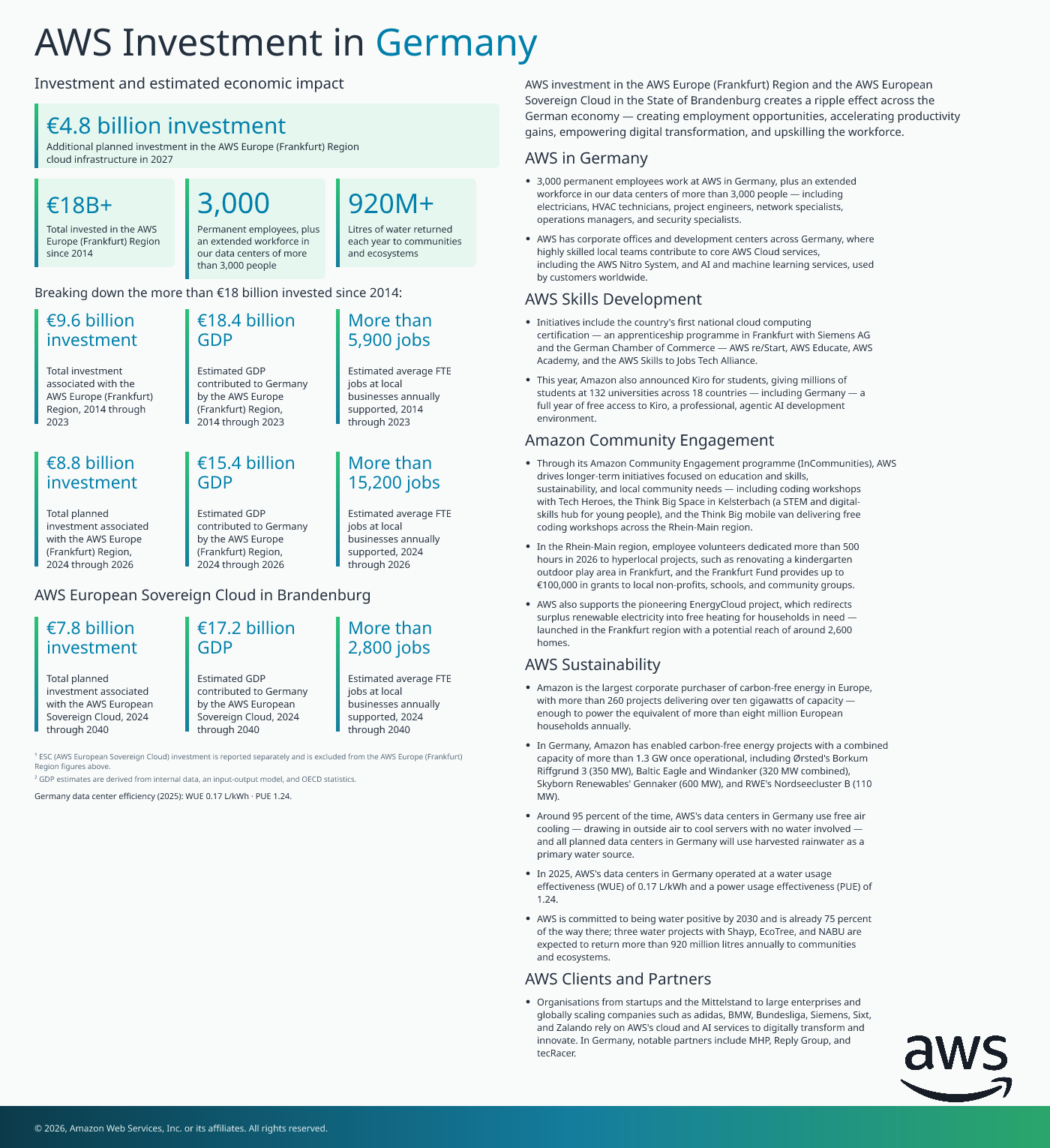
AWS’s commitment to Germany extends beyond the AWS Frankfurt Region. To help public sector organisations and customers in highly regulated industries meet their evolving sovereignty needs, AWS launched the AWS European Sovereign Cloud in Brandenburg in January 2026. This independent cloud for Europe - physically and logically separate from other AWS Regions - is backed by a planned investment of €7.8 billion from 2024 to 2040, and is estimated to contribute €17.2 billion to Germany’s economic output while supporting an annual average of 2,800 jobs over the investment period.
“Our continued investment in Germany reflects a deep commitment to the country’s digital future. Since 2014, we have invested more than 18 billion euros, supported thousands of skilled jobs, and contributed significantly to economic growth. These investments drive innovation far beyond Germany. In addition to supporting businesses and public sector organizations across Germany to adopt AI and cloud, our highly skilled local development teams help build the cloud services for compute, database, security and AI our customers use worldwide. We will keep supporting German businesses as they build the future and compete globally,” said Stefan Höchbauer, Vice President von AWS Global Sales Germany und Europe Central.
Amazon Web Services (AWS) today announced plans to invest an additional €8.8 billion into its existing cloud infrastructure in the AWS European (Frankfurt) Region to meet growing customer demand for cloud services in Germany. According to the new AWS Economic Impact Study (EIS) for Germany, released today, this planned investment is estimated to support 15,200 full-time equivalent (FTE) jobs in local German businesses annually. Having invested €9.6 billion in Germany from 2014 to 2023, AWS contributed an estimated €18.4 billion to Germany’s gross domestic product (GDP), while supporting over 5,900 annual jobs over that ten-year period. Today's €8.8 billion planned investment announcement is estimated to add €15.4 billion to Germany’s GDP and support over 15,200 jobs annually from 2024-2026.
AWS also announced last month plans to invest €7.8 billion from 2024-2040 in the AWS European Sovereign Cloud. The first AWS European Sovereign Cloud will launch in Brandenburg in Germany by the end of 2025, and is estimated to contribute €17.2 billion to Germany’s economic output while supporting an annual average of 2,800 jobs from 2024 to 2040.
How big is AWS’s footprint in Germany?
AWS has 3,000 permanent employees, plus an extended workforce in our data centers of more than 3,000 employees, including electricians, HVAC technicians, project engineers, network specialists, operations managers, security specialists, and other skilled positions. AWS has corporate offices and development centers across Germany, where highly skilled teams contribute to core AWS Cloud services, including the AWS Nitro system, AI and machine learning services, and more.
- AWS European Sovereign Cloud, launched in January 2026
- AWS Europe (Frankfurt) Region, launched in 2014
- AWS Local Zone launched in Hamburg in October 2024
- 59 Amazon CloudFront Points of Presence nationwide
- Five AWS Direct Connect locations in Berlin, Frankfurt, Hamburg, and Munich
- Three WaveLength Zones in Berlin, Dortmund, and Munich
How is AWS empowering Germany’s cloud workforce?

AWS invests in workforce training programmes to provide accessible cloud learning to upskill the next generation of tech workers in Germany. Initiatives include the country’s first national cloud computing certification - an apprenticeship programme in Frankfurt in collaboration with Siemens AG and the German Chamber of Commerce - AWS re/Start, AWS Educate, AWS Academy, and the AWS Skills to Jobs Tech Alliance. This year, Amazon also announced Kiro for students, giving millions of students at 132 universities across 18 countries — including Germany — a full year of free access to Kiro, a professional, agentic AI development environment, so they enter the workforce ready to build with AI from day one.
What does Amazon do for communities in which it operates?

InCommunities, the Amazon Community Engagement program, drives longer-term initiatives in the communities in which AWS operates data centers. Those initiatives focus on education and skills development, sustainability, and addressing the needs of local communities.
Key initiatives include coding workshops with Tech Heroes, the Think Big Space in Kelsterbach - a community hub offering STEM education (Science, Technology, Engineering, Mathematics) and digital skills programmes to young people - and the Think Big mobile van, visiting schools and community hubs to deliver free coding workshops across the Rhein Main region.
Beyond education, in the Rhein-Main Region employee volunteers have dedicated more than 500 hours in 2026 to hyperlocal projects, like the renovation of a kindergarten school outdoor play area in Frankfurt. AWS also established the Frankfurt Fund to provide up to €100,000 in grants to local non-profits, schools, and community groups.
Amazon is also supporting a pioneering EnergyCloud project that converts surplus renewable energy into free heating for families. The programme automatically redirects surplus renewable electricity into free heat using smart storage heaters for households in need. The initiative launched in the Frankfurt region with a potential reach of approximately 2,600 homes. Building on that success, EnergyCloud Germany will expand the programme to additional regions as part of its ambition to establish a nationwide platform ensuring surplus renewable energy supports households across Germany.
How is AWS making its German data centers more sustainable?

Amazon is the largest corporate purchaser of carbon-free energy in Europe, with more than 260 projects delivering over ten gigawatts of capacity across the region — enough to power the equivalent of more than eight million European households annually. In Germany, Amazon has enabled carbon-free energy projects with a combined capacity of more than 1.3 GW once operational, including offshore wind farm projects such as Ørsted’s Borkum Riffgrund 3 (350 MW), Iberdrola’s Baltic Eagle and Windanker (320 MW combined), Skyborn Renewables’ Gennaker (600 MW), and RWE’s Nordseecluster B (110 MW).
Responsible water management is also central to how AWS operates its data centres. Around 95 percent of the time, AWS’s data centres in Germany use “free air cooling” — pulling in outside air to cool servers with no water involved. When evaporative cooling is needed on the warmest days, it uses minimal water. All planned data centres in Germany will use harvested rainwater as a primary water source, minimising demands on community water resources and reducing potential stormwater runoff.
AWS is committed to being water positive by 2030 — returning more water to communities than it uses in its data centre direct operations — and is already 75 percent of the way there. In Germany, AWS is actively investing in water replenishment and leak detection projects in the greater Frankfurt region. Through collaborations with Shayp, EcoTree, and NABU (Naturschutzbund Deutschland), AWS has announced three projects combining smart technology with nature-based solutions — from IoT-based leak detection in 500 Frankfurt buildings to wetland restoration in the Spessart Forest and the Vogelsberg region of Hesse. Once completed, these projects are expected to return more than 920 million litres of water annually to communities and ecosystems.
“These projects in Germany demonstrate how technology and nature-based solutions can help us use water more efficiently, reducing waste and ensuring this vital resource is available for communities now and in the future,” said Michael Hanisch, Head of Technology at AWS Germany.
In addition, AWS helps its customers build more sustainably in the cloud. AWS provides tools like the AWS Well-Architected Sustainability Pillar, AWS Customer Carbon Footprint Tool, and Amazon Sustainability Data Initiative to help customers improve their cloud architectures, measure emissions, forecast future impacts, and accelerate sustainability research and innovation.


